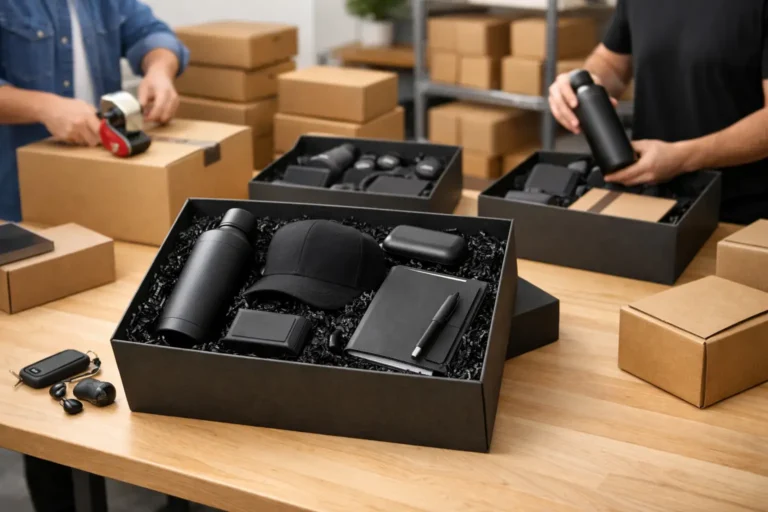
A delayed launch rarely fails because of the creative. It usually stalls in the handoff between print, inventory, packing, and shipping. That is where branded promotional kit assembly becomes a real operational advantage. When kits are planned and produced as one coordinated workflow, businesses move faster, protect brand consistency, and reduce the cost of managing multiple vendors.
For marketing teams, procurement leaders, and operations managers, promotional kits are not just boxes of branded items. They are timed customer communications, sales enablement tools, onboarding materials, event support assets, or member welcome packages. If one insert is missing, one version is outdated, or one shipment arrives late, the impact reaches far beyond packaging.
What branded promotional kit assembly actually includes
Branded promotional kit assembly is the process of bringing together printed materials, cards, promotional items, packaging components, variable inserts, and shipping instructions into one finished package that is ready for distribution. Depending on the program, that may include welcome letters, brochures, membership cards, product samples, branded merchandise, instructions, and personalized documents.
The work sounds simple until volume, version control, and deadlines enter the picture. A 200-kit campaign for one audience is manageable in-house. A 20,000-kit rollout with regional variations, regulated content, and staggered shipping dates is a different operation entirely. At that point, assembly is less about packing and more about process control.
A strong assembly program covers procurement coordination, inventory management, print production, personalization, quality checks, packaging standards, postage planning, and final distribution. When these steps are fragmented across vendors, delays and errors tend to multiply. When they are managed together, timelines tighten and accountability becomes clearer.
Why kit assembly breaks down inside growing organizations
Many businesses start by handling kits internally. It feels practical at first, especially for smaller launches or pilot programs. The problem is that internal teams are often built to manage strategy, customer communications, or procurement, not warehouse flow and fulfilment accuracy.
Marketing may own the campaign. Operations may own inventory. Procurement may source the items. Customer service may need exact delivery timing. If no single process governs the program, kit assembly becomes a chain of manual follow-ups. That usually leads to rushed packing, duplicate effort, excess inventory, and expensive last-minute freight.
There is also the issue of storage. Promotional campaigns often rely on components arriving from different suppliers at different times. Without organized receiving, tracking, and replenishment, businesses either run short on key items or over-order to avoid stockouts. Neither option supports cost control.
Compliance can add another layer. In healthcare, insurance, financial services, or membership programs, kits may include personalized information, regulated disclosures, or version-specific documents. In those environments, branded promotional kit assembly must be precise, auditable, and aligned with data handling requirements. A packing error is not just an inconvenience. It can create customer confusion, operational rework, and reputational risk.
The business case for a single-source workflow
The clearest benefit of outsourcing assembly to an integrated partner is operational consolidation. Instead of coordinating print vendors, merchandise suppliers, mail houses, and fulfilment providers separately, businesses can move the work through one managed production stream.
That changes more than convenience. It improves speed to market because artwork, personalization, assembly instructions, and shipping logic are managed together. It improves accuracy because the same production environment can verify components before a kit is packed. It also improves cost visibility because purchasing, production, storage, and distribution are planned as one program rather than as disconnected line items.
This matters most for recurring campaigns and multi-touch programs. If your organization sends broker kits, sales kits, employee onboarding packs, member welcome packages, dealer support materials, or direct mail promotional bundles on a regular basis, consistency becomes a measurable business asset. The process should be repeatable, scalable, and easy to adjust when campaign details change.
For organizations serving customers across Canada and the United States, distribution complexity is another factor. Packaging standards, postal considerations, customs planning, and delivery timing all affect the final result. A kit that looks right in a boardroom can still fail in transit if it was not assembled for real-world shipping conditions.
What to look for in a branded promotional kit assembly partner
The right partner should do more than pack materials into a box. You need a provider that can control the full execution chain and support changes without slowing the program down.
Print capability matters because many kits rely on time-sensitive inserts, versioned collateral, or personalized documents. If print production is handled separately from assembly, every revision adds another coordination point. When print and assembly are integrated, version control is tighter and turnaround is easier to manage.
Inventory visibility matters just as much. A dependable partner should be able to receive components, track stock levels, flag shortages early, and align replenishment with campaign schedules. This is especially valuable when kits include a mix of printed pieces, branded merchandise, and program-specific materials.
Quality control should be built into the workflow rather than added at the end. That includes checking the right versions, confirming counts, validating personalization when applicable, and inspecting packaging before shipment. In regulated industries, documented processes are not optional. They support accuracy, accountability, and customer confidence.
Scalability is another practical requirement. Some campaigns run once a year. Others require daily, weekly, or monthly kit distribution tied to customer enrolment, sales activity, or program demand. Your assembly process should be able to handle both scheduled bulk runs and ongoing fulfilment without creating separate systems.
Packaging decisions affect more than appearance
Businesses often focus on what goes into the kit and overlook how the kit is built. Packaging influences postage cost, damage rates, warehouse handling, and the customer experience.
A premium box may support a high-value brand presentation, but it can also increase dimensional shipping costs. Lightweight mailers may reduce freight expense, but they are not right for every item mix. Custom inserts can protect materials and improve presentation, although they add design and production complexity. The best choice depends on the program objective, shipment profile, and budget.
This is where experience matters. Good branded promotional kit assembly balances visual impact with practical execution. A package should arrive intact, represent the brand properly, and move through the shipping network efficiently. If any of those factors are ignored, the apparent savings disappear quickly.
Personalization, versioning, and data-sensitive programs
Not every promotional kit is generic. In many sectors, kits need to be personalized by audience, region, language, product line, membership status, or regulatory requirement. That can mean inserting different letters, cards, forms, or promotional offers based on business rules.
Manual handling is risky in this kind of environment. The more versions involved, the greater the chance of mismatched components. Integrated data processing and fulfilment controls help reduce that risk. Instead of treating personalization as a separate step, the best workflows connect data, print, assembly, and shipping logic from the start.
This is particularly relevant for organizations that manage member communications, insurance materials, healthcare programs, or financial service documents. Precision is part of the brand experience, but it is also part of compliance. Businesses need fulfilment partners that understand both.
When outsourced assembly delivers the strongest return
Outsourcing is not always necessary for every campaign. If your volume is low, your kit has only a few static components, and timing is flexible, internal handling may be sufficient. But once the program involves recurring shipments, multiple SKUs, strict timelines, personalization, or cross-border distribution, the economics usually change.
At that point, internal assembly starts consuming time from higher-value teams. Storage becomes inefficient. Expedite fees become more common. Errors become harder to trace. A managed assembly and fulfilment model can save time and money by reducing those hidden costs.
For many organizations, the biggest return is not labour reduction alone. It is the ability to streamline operations, launch faster, and trust that fulfilment will keep pace with demand. That kind of reliability supports sales, customer retention, and program growth.
MixtoMart supports this model by combining print, personalization, kit assembly, fulfilment, and distribution within one execution environment. For businesses that need control, speed, and fewer moving parts, that consolidated approach is often the difference between a campaign that merely ships and one that performs.
Branded promotional kits should not create operational drag. When assembly is treated as a disciplined production workflow instead of an afterthought, businesses gain a faster path from concept to delivery, with fewer handoffs and better results where it counts most – in the hands of the customer.