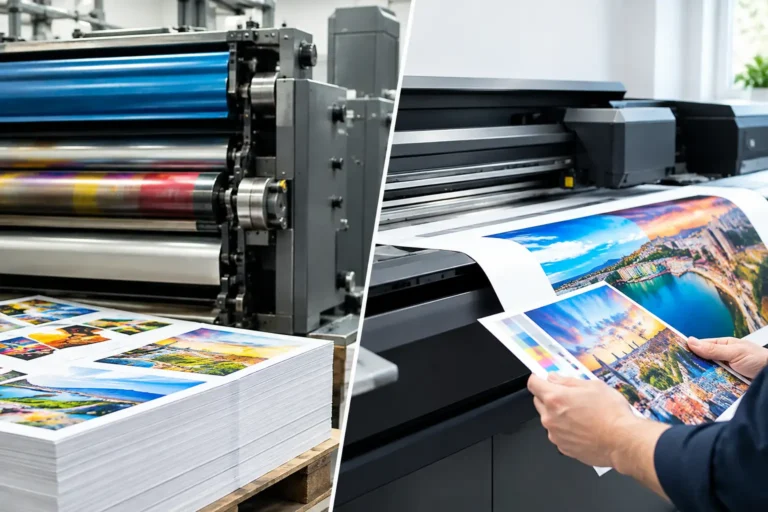
A print decision can affect far more than the appearance of a finished piece. For organizations managing member cards, direct mail, benefit packages, compliance notices, or campaign materials, offset versus digital printing affects unit cost, turnaround, personalization, inventory, and delivery execution. The right choice depends on the job’s volume, versioning requirements, brand standards, and how the finished materials move through your operation.
Offset Versus Digital Printing: Core Differences
Offset printing transfers an inked image from metal plates to a rubber blanket and then onto paper or another substrate. It is a production method built for consistency and efficiency at higher volumes. Once plates are created and the press is set up, offset can produce large runs with strong colour control and a low per-unit cost.
Digital printing applies toner or ink directly from a digital file. It does not require printing plates, which reduces setup time and makes short runs practical. It also supports variable data printing, allowing individual names, account information, barcodes, offers, or images to change from one piece to the next.
Neither method is automatically better. A 100,000-piece static insurance insert and a 2,000-piece personalized renewal mailing should not be approached in the same way, even if both use the same paper size and brand colours.
When Offset Printing Makes Business Sense
Offset is often the stronger option when volume is high, artwork is stable, and colour accuracy is a priority. It is commonly used for large quantities of brochures, catalogues, forms, packaging components, inserts, statement shells, and standardized program materials.
The main advantage is production economics. Offset requires upfront preparation for plates, press setup, and colour calibration. Those fixed costs can make a small run expensive, but they are spread across a large quantity as volume increases. For a long-run project, the unit cost can be considerably lower than digital production.
Offset also provides broad flexibility in paper stocks, coatings, specialty inks, and finishing. If a marketing team requires a precise brand colour, metallic ink, a specific uncoated stock, or a distinctive tactile finish, offset may offer the most reliable path to the desired result. This matters for premium direct mail, annual reports, retail collateral, and materials where colour consistency must remain steady across a national distribution.
There are trade-offs. Offset usually needs more lead time because plates must be produced and the press configured. It is less suited to frequent content changes or jobs where every document contains unique recipient data. It can also create inventory pressure when an organization orders a large quantity before it knows how quickly materials will be used.
When Digital Printing Is the Better Operational Choice
Digital printing is designed for speed, flexibility, and controlled quantities. Without plates or lengthy press setup, production can begin quickly after files and data are approved. That makes digital a practical fit for short-run collateral, urgent communications, pilot campaigns, localized materials, and replenishment orders.
Its most significant advantage is personalization. A healthcare provider can produce patient-specific outreach. An insurer can create policyholder communications with individualized coverage details. A membership program can add names, unique IDs, barcodes, and targeted offers to every mail piece. These applications turn print from a static asset into a relevant customer communication.
Digital also reduces the risk of obsolete inventory. Rather than producing six months of forms, kits, or promotional materials at once, organizations can print in smaller batches based on actual demand. This approach is especially valuable when pricing, regulations, program details, or brand messaging may change during the year.
For many operational teams, the speed of digital production supports faster response times. A program administrator can approve an update, trigger production, and move materials into fulfillment without waiting for a conventional press schedule. When paired with mailing, kitting, and distribution, this can shorten the time between a business decision and customer delivery.
Digital printing does have limits. At very high volumes, the per-piece cost may be higher than offset. Certain specialty inks, substrates, and finishing treatments may also be more practical through offset production. For colour-sensitive projects, proofing remains essential, as results can vary by device, stock, and production process.
Compare Cost Beyond the Print Price
The price per printed sheet is only one part of the decision. Procurement teams should evaluate the total operating cost, including setup, storage, version changes, waste, fulfillment labour, postage, and the cost of delayed communications.
A large offset run may look economical on a unit-cost basis, but the savings can shrink if materials sit in a warehouse, become outdated, or require rework after a program change. Digital may cost more per piece, yet save money when it prevents overproduction and enables on-demand replenishment.
The same principle applies to personalized direct mail. Digital production can combine variable text, imaging, and mailing data in a controlled workflow. If personalization improves response rates, reduces returned mail, or directs recipients to the correct program information, the business value may outweigh a modest difference in print cost.
For regulated sectors, reprints caused by outdated language or inaccurate data can be particularly expensive. A production plan should account for approval controls, version management, secure data handling, and documented quality checks, not simply the initial print quote.
Quality, Colour, and Brand Consistency
Both technologies can produce professional customer-facing materials. The question is what type of quality matters most for the application.
Offset is widely trusted for precise colour matching and consistent results across long runs. It is often preferred for high-visibility brand campaigns, corporate stationery, detailed imagery, and projects with demanding colour specifications. Spot colours and custom ink formulations can help protect brand standards where standard process colour is not enough.
Digital delivers strong quality for a broad range of business applications and has advanced substantially. It is especially effective for transactional documents, personalized campaigns, short-run brochures, cards, inserts, and kits. For many programs, the practical benefits of quick production and variable content are more valuable than the marginal visual differences between methods.
A proofing process should be part of either approach. Confirm colour expectations, trim, folds, stock, variable fields, barcode readability, and finishing before full production begins. For cards and other durable materials, testing should also cover durability, encoding requirements, and compatibility with the intended use.
Personalization Changes the Printing Decision
If every recipient receives identical content, offset may be an efficient choice at scale. If messages, identifiers, language, offers, or images change by recipient, digital printing is usually the practical production method.
Variable data printing supports more than a name in a salutation. It can segment communications by location, member status, vehicle type, policy renewal date, service history, or campaign response. This enables organizations to maintain one controlled template while delivering relevant versions to each audience.
Personalization must be supported by disciplined data processing. Source files need validation, records need to be matched correctly, and suppression rules must be applied before production. For healthcare, financial services, and insurance organizations, data compliance and secure handling should be designed into the workflow from file intake through printing, mailing, return mail processing, and reporting.
Choose a Production Model, Not Just a Press
Many organizations benefit from using both methods. Offset can produce high-volume, standardized components such as outer envelopes, generic inserts, folders, or program collateral. Digital can then add personalized documents, labels, cards, and localized materials as orders are released.
This hybrid approach can reduce costs while preserving flexibility. It also supports efficient kitting, where pre-produced components are stored and combined with on-demand personalized items. Instead of coordinating separate print, mail, and fulfillment vendors, teams can manage the program through a consolidated production workflow.
MixtoMart helps organizations assess these choices in the context of the full operation: print specifications, data processing, personalization, inventory, kitting, postal preparation, fulfillment, and digital delivery. That wider view helps prevent a low print price from creating higher costs elsewhere in the program.
Before selecting a method, confirm the expected quantity, number of versions, personalization needs, deadline, colour requirements, storage capacity, and distribution plan. A clear production brief gives your print partner the information needed to recommend the most efficient route.
The best print program is the one that delivers the right material, to the right recipient, on time, without creating avoidable inventory, data, or vendor-management work for your team.