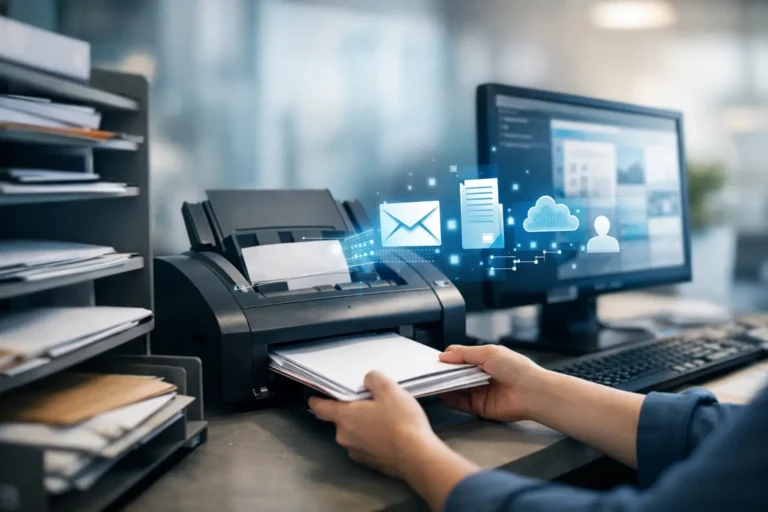
A delayed piece of correspondence can create more than an administrative inconvenience. For an insurer, it may delay a claim. For a healthcare organization, it can hold up a member request. For a financial services team, it may create a compliance exposure or a poor customer experience. Digital mailroom transformation trends are therefore moving beyond basic scanning. Organizations are redesigning how inbound documents, payments, forms, returned mail, and customer communications are received, validated, routed, stored, and acted on.
For operations leaders, the goal is not simply to convert paper into PDFs. It is to reduce handling time, protect sensitive data, create a reliable audit trail, and move each item to the right workflow without adding internal complexity. The most effective programs combine physical mail expertise, secure data processing, digital delivery capabilities, and clear accountability across the full communication lifecycle.
Digital Mailroom Transformation Trends That Matter
Mail intake is becoming a managed workflow
Traditional mailrooms often depend on manual sorting, departmental handoffs, and inbox-based decision-making. That approach becomes difficult to manage when volume fluctuates, deadlines are tight, or documents contain personal health, financial, or insurance information. A digital mailroom treats incoming mail as structured work from the moment it arrives.
Mail is received, opened, classified, scanned, indexed, and routed according to defined business rules. A provider can identify document types such as applications, remittance notices, claim documents, correspondence, or returned statements, then direct them to the appropriate queue or system. This gives teams better visibility into what has arrived, where it is in the process, and whether service-level targets are being met.
The operational benefit is significant: fewer documents sit in trays or shared inboxes waiting for someone to interpret them. However, automation should not remove judgment where it is needed. Exceptions, incomplete forms, poor-quality originals, and high-risk documents still require trained review. The right model automates repeatable work while creating a controlled path for exceptions.
Data capture is being tied to business action
Scanning alone does not create efficiency if employees must manually read every image and rekey information into another application. The next stage of digital mailroom maturity is intelligent data capture. Information such as account numbers, member IDs, invoice details, addresses, dates, and document categories can be extracted, validated, and associated with the relevant workflow.
Accuracy rules matter as much as speed. A misread account number or incorrectly classified form can send work to the wrong team and cause downstream errors. Organizations should define confidence thresholds, verification procedures, and escalation rules before increasing automation. For regulated industries, data capture must also support traceability: who processed the item, when it was received, what was changed, and how it was delivered.
This is where a production and fulfillment partner can add practical value. Secure scanning, data processing, print production, return mail handling, and digital distribution should operate as connected services, rather than as separate vendor relationships that create gaps in accountability.
Hybrid communications are replacing paper-only processes
Many customer communications still require print. Physical mail remains necessary for regulated notices, cards, welcome kits, documents requiring original signatures, and audiences that prefer or depend on paper delivery. Digital mailroom transformation does not mean eliminating print at any cost. It means choosing the most effective delivery method for each communication.
Organizations are increasingly managing inbound and outbound communications through coordinated hybrid workflows. A returned statement can trigger an address correction process. A scanned enrolment form can initiate a fulfilment request for a health benefit card and printed welcome materials. A customer communication can be delivered digitally when consent and channel preference allow, while a physical version is produced for recipients who require mail.
This approach reduces duplicate work and gives program teams more control over timing, personalization, and delivery choices. It also supports continuity when postal disruptions, volume spikes, or staffing constraints affect one channel. The trade-off is that hybrid delivery requires disciplined data management and clear rules about consent, retention, and channel selection.
Security and compliance are moving to the centre of the design
For healthcare, insurance, financial services, and membership programs, sensitive correspondence cannot be treated as routine office mail. Digital mailroom programs are increasingly designed around controlled chain of custody, access management, secure handling, and documented procedures.
Physical controls remain essential. They include secure receiving areas, controlled access, monitored processing, documented destruction procedures, and accountable handling of originals. Digital controls are equally critical: role-based access, encryption, secure storage, retention schedules, activity logging, and procedures for handling suspected privacy incidents.
Compliance requirements vary by organization, jurisdiction, document type, and customer agreement. A standard process may be appropriate for general marketing responses, while health information or financial correspondence may require stricter controls and separate processing rules. Procurement teams should look beyond broad security claims and assess the actual workflow: where mail is received, how images are created, who can access data, how exceptions are handled, and how records are retained or destroyed.
Return mail is becoming a source of operational intelligence
Returned mail has often been treated as a downstream problem – a cost to process after a communication has already failed to reach its recipient. More organizations are now using return mail processing to improve address quality, reduce future waste, and protect customer relationships.
When undeliverable items are captured, categorized, and connected to customer records, organizations can identify recurring address issues, flag accounts for outreach, update eligible records, and prevent repeated mailings to invalid addresses. For card programs, policy notices, invoices, and renewal communications, this can reduce both reprint expense and customer service calls.
The value depends on how quickly return data is processed and whether there is a reliable path for making approved updates. A box of returned envelopes delivered weeks later offers limited value. A controlled workflow that scans, codes, reports, and routes return information creates a more useful operational signal.
What a Scalable Digital Mailroom Requires
A scalable program starts with volume, document types, service targets, and risk. An organization receiving a few hundred documents monthly will not need the same workflow as an insurer processing time-sensitive claims correspondence or an enterprise managing multiple regional offices. The process should match the operational need without creating unnecessary technology or approval layers.
Leaders should also map the full journey, not just the scan step. Consider receipt, sorting, preparation, image quality review, data capture, indexing, exception handling, routing, original-document retention, reporting, and destruction. If outbound print and fulfilment are connected to the same program, include personalization, inventory, kitting, postal preparation, delivery, and return mail processing in the design.
Clear performance measures make the program manageable. Useful measures include receipt-to-routing time, capture accuracy, exception rates, turnaround by document type, return mail volume, rework, and cost per item. These metrics help teams identify whether a delay comes from mail intake, unclear business rules, insufficient staffing, data quality, or an overloaded approval process.
Vendor consolidation is another major consideration. Using one partner for scanning, data processing, document production, mailing, fulfilment, and digital distribution can reduce handoffs and simplify accountability. It is not always the right choice if a specialized system must remain in place, but the provider should still be able to integrate cleanly with existing operational workflows and reporting requirements.
Building for Growth Without Adding Complexity
The strongest digital mailroom programs are designed for change. Volumes can rise during renewals, open enrolment, claims events, seasonal campaigns, or regulatory communications. Document formats change. New customer channels emerge. A process that works only under normal conditions will quickly become a bottleneck.
MixtoMart helps organizations bring physical and digital communication processes together through secure document handling, scanning, data processing, print, fulfillment, mailing, and return mail services. That consolidated approach gives teams a practical way to reduce vendor coordination while maintaining the precision, customization, and data compliance their programs require.
The next useful step is to identify one mail-driven process where delays, manual handling, or returned items create measurable cost. Improve that workflow first, define the controls and service targets, then expand from a proven operational foundation. That is how a digital mailroom becomes a dependable part of service delivery rather than another system for teams to manage.