A delayed mail campaign rarely fails because of the design. It usually fails in the handoff between print, data, inserting, sorting, and postal preparation. That is where postal lettershop services make a measurable difference. For organizations sending invoices, policy documents, member kits, benefit materials, promotional mail, or regulated customer communications, the right lettershop process reduces friction, controls costs, and keeps delivery timelines on track.
For many businesses, mail is still a critical operational channel. Customers need physical cards, statements, notices, and welcome packages. Marketing teams still rely on direct mail for response and retention. Program administrators need dependable delivery for recurring communications. When those workflows are managed across multiple vendors, delays and errors tend to multiply. Postal lettershop services solve that problem by bringing production and mail preparation into a controlled, repeatable system.
What postal lettershop services actually cover
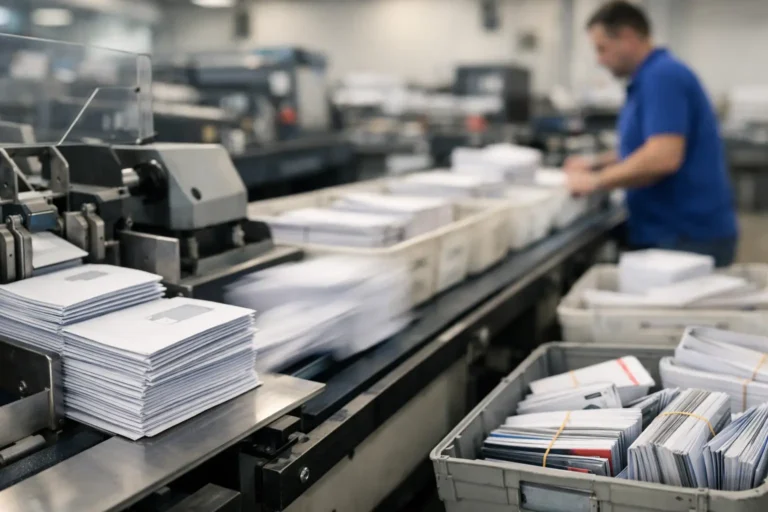
Postal lettershop services are the operational steps that happen between document production and final induction into the mail stream. That includes addressing, personalization, matching, folding, inserting, inkjetting, tabbing, sealing, sorting, presorting, tray or sack preparation, and postal documentation. In many programs, it also includes data processing, deduplication, address hygiene, tracking support, and return mail handling.
This work matters because mail is not just a printed piece. It is a fulfilment process with compliance, timing, and cost implications. A healthcare mailer, for example, may require personalized inserts, strict file controls, and audit-ready production. A financial services mailing may depend on exact matching between account-level data and enclosed materials. A membership program may need branded cards, carrier letters, and fulfillment components assembled in sequence. If any part of that chain breaks, service levels suffer.
The value of a lettershop is not simply that it prepares mail. The value is that it prepares mail correctly, efficiently, and at scale.
Why postal lettershop services matter to operations teams
Operations leaders are often judged on consistency, turnaround times, and cost control. Postal lettershop services support all three. When print and mailing workflows are coordinated under one operational framework, there are fewer touchpoints to manage, fewer file transfers, and fewer opportunities for mismatch.
That consolidation has a direct impact on speed. Instead of sending printed materials to one provider, mailing data to another, and then relying on outside coordination for postal induction, organizations can move from approved files to finished mail with less administrative drag. That means faster campaign launches, faster customer communication cycles, and fewer internal resources tied up in vendor management.
There is also a quality advantage. Lettershop workflows rely on machine controls, file logic, and production checkpoints that are designed to reduce errors. Piece-level matching, barcode controls, camera verification, and automated sorting all contribute to better accuracy. For regulated industries, that is not optional. It is part of protecting customer trust and meeting internal governance standards.
The cost side is more nuanced than it looks
Some organizations evaluate lettershop providers based only on print pricing or unit mailing costs. That is rarely the full picture. Postal lettershop services affect total program cost in several ways, including labour reduction, postage optimization, waste control, and rework avoidance.
Presorting and mail preparation can lower postage rates when the job is structured correctly. Address cleansing can reduce undeliverable mail. Better data handling can limit duplicates and suppress records that should not be mailed. Accurate inserting and matching reduce the cost of reruns and customer service escalations. These savings are practical, not theoretical.
That said, the lowest price is not always the best fit. If a provider cannot manage variable data, complex inserts, recurring mail schedules, or compliance requirements, low unit pricing can quickly become expensive. It depends on the complexity of the job, the risk profile of the mailing, and the internal cost of fixing errors after the fact.
Where businesses see the biggest gains
The strongest results usually come from recurring or multi-component mail programs. Monthly statements, annual renewals, policy packs, ID card mailers, explanation of benefits documents, loyalty communications, and direct mail campaigns all benefit from disciplined postal preparation.
In these environments, standardization creates efficiency. Templates are established, data rules are documented, insert logic is tested, and postal specifications are built into the workflow. Once that process is in place, teams can scale volume more easily without recreating the job every cycle.
This is especially useful for organizations operating in healthcare, insurance, financial services, automotive support programs, and membership-based services. These programs often involve personalized materials, recurring deadlines, and customer-facing documents that cannot afford production shortcuts.
What to look for in a postal lettershop partner
Not every provider offers the same depth. Some handle basic inserting and mailing. Others can manage the broader production environment, from data intake through print, personalization, fulfilment, and return mail. For business buyers, that difference matters.
Start with process control. A capable partner should be able to explain how files are received, validated, and secured, how mail pieces are matched and verified, how postal specifications are applied, and how production quality is monitored. If those answers are vague, the risk is usually hiding in the workflow.
Next, assess scalability. Can the provider handle daily transactional mail and larger campaign bursts? Can they support multiple formats, variable page counts, selective inserts, and custom packaging requirements? A provider may be reliable at one volume range and inefficient at another.
Data compliance should also be central, especially when customer or member information is involved. For regulated industries, postal lettershop services are closely tied to privacy controls, file handling discipline, and traceable production steps. This is one area where operational maturity matters more than sales language.
Finally, look at service integration. The more fragmented the workflow, the more time your team spends coordinating handoffs and resolving issues. A single-source model can save time and money because it reduces the number of vendors, contacts, and process gaps involved in getting communications out the door.
Integration changes the economics of mail
The real advantage of modern lettershop operations is not the machine floor alone. It is the integration between data, print, fulfilment, and postal execution. When those functions work together, jobs move faster and with fewer exceptions.
For example, a customer communications team may need personalized letters, branded cards, fulfilment inserts, and mail tracking prepared on a strict schedule. If each element is handled separately, small delays at each stage create larger delivery problems. When the workflow is integrated, approvals are clearer, scheduling is tighter, and production decisions can be made with the full job in view.
This also improves visibility. Teams can plan campaigns and operational mailings based on actual production capacity and postal timing instead of assumptions. That leads to better forecasting and fewer deadline escalations.
When postal lettershop services need customization
There is no single format that works for every organization. A direct mail campaign focused on acquisition will have different priorities than a regulated benefits communication. One may emphasize response rates and postal efficiency. The other may prioritize matching accuracy, auditability, and timed delivery.
Customization matters in areas such as insert logic, packaging, sequencing, frequency, data formatting, and return mail workflows. It also matters for branding. Customer-facing materials need to arrive looking consistent and professional, especially when they represent a healthcare plan, financial institution, insurer, or membership program.
This is where an experienced provider can add value beyond execution. By aligning lettershop operations with program goals, they help ensure that mailing is not treated as a final step but as part of the overall customer delivery strategy.
Postal lettershop services as a business efficiency tool
For many organizations, mail remains essential, but managing it internally or across disconnected vendors consumes more time than it should. Postal lettershop services bring order to that complexity. They support faster turnaround, better postage management, improved accuracy, and stronger control over customer communications.
For companies looking to streamline operations, reduce vendor complexity, and improve delivery consistency, this is not just a mailing function. It is an operational advantage. Providers such as MixtoMart support that model by combining print, personalization, fulfilment, data handling, and postal execution in one environment built for speed, scale, and compliance.
The most effective mail programs are not simply sent. They are engineered to move efficiently from data to mailbox with fewer delays, fewer errors, and less work for your team.